Thank you so much for all the wonderful, kind, and supportive comments on our new addition! Rule, as she has been christened, says thank you.
Today Im participating in the Positive Pet Training Blog Hop, hosted by Rubicon Days, Tenacious Little Terrier, and Cascadian Nomads. Januarys theme is "National Train You Dog Month", and as always, any positive-based training posts are accepted.
I debated on doing a sort of "Plans for 2016" training post, but quickly dropped the idea in favor of something Ive been really enjoying lately, and something that I feel is invaluable to those of us with active dogs, or any dogs, really!
Whats that, you ask? Fitness, and how to keep your dogs body strong and healthy!
2015 was my year of getting fit and healthy. I quit sugar in late December of 2014, and aside from yogurt, peanut butter, and natural sugars like fruit and honey, havent had any since then. Ive kept up with yoga 4-7 days a week. I started running and walking, and have been consistently doing 5 to 10 miles a day. I quit gluten, Im careful with getting enough sleep, and eat incredibly healthy.
I had one small cold in October, but was otherwise 100% healthy. In the years before, Id be sick 5+ times a year. My moods are stable, my skin is clear for the first time in my life, I feel amazing, and I am so happy. I cant imagine its much different for our dogs!
Having a fit and healthy dog has always been a top priority of mine. The vast majority of dachshund owners do not exercise their dogs, leading to overweight dogs and more back problems than you can shake a stick at. I refuse to have that for my Doxie girls, or Pike or Rule. Aside from a good diet, exercise is one of the best tools for a healthy dog. These are some simple, fun training activities you can do with your dog to help increase strength, balance, flexibility, and overall stamina.
Disclaimer: Know thy dog. These exercises are preformed by young, healthy dogs with no medical problems. Be careful!
Parkour
Something Ive become a little obsessed with lately is Parkour for dogs, or "Barkour", as it is sometimes called. Parkour training is a way of using your environment as an obstacle course, involving climbing, jumping, running, vaulting, ect. Its the same thing for dogs!
I like it because you dont need any fancy equipment (Im cheap!), and anywhere you go can offer different challenges for you and your dog. Everything from trees to fences to picnic tables to playgrounds can be used! You can even earn titles in the sport from The International Dog Parkour Training Association. I may try both Nola and Rule for these soon.
I only started the girls on this about a week and a half ago, but already theyre picking it up and loving it. Its Nolas favorite time of day!
Some cues used in the below photos:
Paws Up! (front feet on object)
Up! (jump onto object)
Pretty (sit pretty/beg)
Stand (stand on hind legs)
Climb (self explanatory)
Up on here (walk along an elevated surface)
Working on climbing on cue! #positivedogtraining #dogtraining #smartdog #climb #dailydog #dachshunds #dachshundnola #dachshundsofinstagram #dogstagram #dogsofinstagram #trainyourdog
A video posted by @dachshund_nola on
Climbing over an obstacle
Were working on going under, too!
Climbing up
Climbing down
Up on a bucket
Up on a cinderblock
Increasing difficulty by having her back feet on the bucket, and her front on my leg.
Climbing
Standing up on a cinderblock. Bonus core and rear workout!
Shes such a happy dog!
Balancing on a narrow board
Paws up
Jumping off
Using a tree to show off "paws up!"
Now the other side!
Rear end awareness on a hunk of lumber.
Paws up
Balancing on a narrow walkway
Tandem paws up!
And again!
Stretching
Any athlete, human or canine, needs to have warm ups, cool downs, and stretches. Warming up literally warms and ready the muscles and sinews for activity. Cool downs allow the body to work out lactic acid, prevents stiffness and soreness, and lets the heart and respiratory rate to return to normal. Stretching helps to maintain flexibility and fluidity, allows blood to better circulate, and greatly reduces the risk of injury.
I do all three of these with the girls before a Parkour session, before a run or long walk, before an intense play session (especially tug), and before working on physically demanding tricks.
For cool warm ups and cool downs, Ill have them do a few sit/down/stand/repeat drills, a quick brisk walk and/or backing up or other rear end awareness exercises. It only takes a few minutes, and helps to get the girls into a training mood.
For stretching, I follow the things listed here. Theyre easy to put on cue!
Conditioning: Poses and Equipment
There are a few great poses your dog can learn to help build muscles. Sit pretty (or beg) is fantastic for building core strength. I do this one a lot with Nola; having a strong back and core reduces the risk of back issues. Standing on the hind legs builds both the rear muscles as well as balance. Holding positioning, or changing position, on some kind of balancing equipment not only builds balance, but also overall strength.
Two great resources on Facebook are Canine Conditioning and Body Awareness, and Structure in Motion - Too!
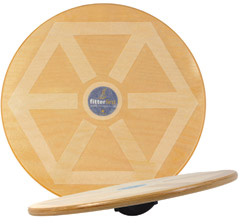
Im a sucker for dog gear of all kinds, and fitness and conditioning gear is no exception. Currently we only have a FitPaws donut, but this month Im planning on ordering several others, including:
Paw Pods
Balance Disc
Peanut
Wobble Board
Since Im cheap, Ill be buying the human version of these (and perhaps having my dad make a wobble board). Half the price and just as sturdy!
Nola and Rule also do 3-5 miles of walking and about a mile of running a day with me, in addition to play, with both me and all the dogs together. Those two are both high energy dogs, while Pike and Olivia lean more towards moderate and low, respectively.
Keeping your dogs in good body conditioning also greatly reduces the risk of injuries. Nola and Rule score as 4s on the Purina body condition chart, where Pike is a 5 and Olivia a 4. Its hard to see on Pike and Liv due to their coats, but you can see it well on the smoothies.
This article by Larry Mueller was published in Outdoor Life 15 years ago, in 1998. Since then the science of genetics and epigenetics have advanced tremendously but the conclusion has not changed that much. If you want to breed superdogs, youd better start really, really early in a dogs life. The next installment will present a current perspective on the points raised in Larrys article.
Building The Superdog
Beginning Before Birth
The where, when, why and how of starting a superdog
Larry Mueller
Hunting Dogs Editor, Outdoor Life, 1998
The new century for dogs is now. Modern science has poised the dog world for a fastforward of unprecedented proportions. In the past, superdogs were rare accidents of nature - naturals that made even first timers believe they were great trainers. And now we know how those accidents happen. We hold the simple secrets to building our own superdogs from scratch.
How early can we begin the conditioning which could lead to a superdog? Five months? Eight weeks? Ninety days? Would you believe… in the womb? Its true. We have scientific evidence that the fetus is not sealed in isolation. It lives in its mothers world.
Interestingly, before Mendel discovered genes, breeders were hunting pregnant bitches to produce superior pups. After Mendels theory caught on, that practice was called an old wives tale. Genetics allowed us to break breeding down to numbers and predict a few traits like coat color. So, we assumed that breeding is a crap shoot of many-sided gene dice. All traits, behavioral and physical alike, were thought to be locked m place at birth. It was a neatly packaged theory that shrank nature to fit our head size. To believe it, however, required ignoring all the loopholes and protecting our ignorance against obvious evidence to the contrary.
But this is for the future. For now, were conditioning fetuses to become great hunting dogs: Proof that its possible comes from the Universityof California, Berkeley. Dr. Marion Diamond, professor of anatomy, divided laboratory rats into two groups. In one rats were housed singly in boxes with just food and water. In the other, groups of rats lived together and enjoyed toys which were changed periodically - a mentally challenging environment.
At maturity, Marion Diamond sacrificed some of both groups and physically measured the cortex areas of their brains. The cortexes had actually grown thicker in the challenged rats. For the first time, it was proven that the anatomy of an animal brain could be changed by experience. Subsequent maze tests m other laboratories proved that rats with thicker cortexes were smarter and quicker to learn.
In a second study, Professor Diamond placed pregnant rats in both deprived and challenging environments. Again, the challenged rats had the thicker cortexes. But get this: So did their offspring! Somehow, the mothers experiences had improved their babies ability to learn.
Can this happen in dogs as well as rats? Of course. As Dr. Diamond points out, the number of neurons in a single column of cortical nerve cells is the same in rats, dogs and man. The number of dendrites (branchlike extensions) and the resulting complexity of circuitry is what creates some of the differences between species.
I asked Professor Diamond whether given the olfactory propensity of dogs and the fact that scent is tasted as well as smelled - there might be a biological connection telling the fetuses that their hunting mother is excited and what odor is responsible. Sound reasonable? "It does," she said, cautioning, however, that she believes everything is possible until proven otherwise.
How might the fetus be conditioned by the mother s experience? My own theory is that tasted odor, like medicine held under the tongue, quickly enters the bloodstream. At the same time, excitement releases adrenaline into the bloodstream. Brain chemicals such as seratonin fire into the gaps between the dendrites. A percentage of those chemicals are recycled to be used again by the brain. The remainder enters the bloodstream, which, in a pregnant bitch, also flows through the unborns brain where it reproduces sensations much like the mothers.
Whether my theory is right or wrong (veterinary neurologist and AuburnUniversityprofessor Larry Myers says Im close, if not dead on) were certain that challenging the pregnant bitch will enlarge the offsprings cortex. Training will be easier. And if my theory is right, the pups will likely have a strong preference for the scent that excites their mother. Deer chasing should be minimized.
I believe that the time to make the greatest impression on the fetus is the last 21 days of gestation. (Since this was published in Outdoor Life, NBC reported that Dr. David Min used ultrasound to track heartbeats and movements of human fetuses. They began responding to parents voices and music at 26 weeks, verifying the third trimester as the time of greatest opportunity for influencing the unborn.)
Additional support for hunting the pregnant bitch comes from Missourieducator, Red Setter breeder and trainer, Bruce Ludwig. Except for heat-of-summer litters, Ludwig hunts his bitches until the last week. "Ive definitely seen more pointing intensity in pups from hunted bitches, Bruce said. And as an educator I see a parallel in children. From all walks of life and degrees of intelligence, those mothers who are physically and mentally active during pregnancy bear children who react noticeably better to sight, sound, and touch. Its most apparent before learned responses form, but it carries over to superior grades later."
But will breeders hunt their pregnant bitches? Should we risk hunting ours? Weve always pampered them. I can only answer with more questions. Have you ever known a coyote who took off two months from hunting to have her pups? Have you ever known a young coyote that wouldnt hunt? Not hunting the pregnant bitch may well be the first step in producing all those worthless dogs we see.