Halloween is lots of fun for kids, but many dogs will be confused or upset by kids in strange costumes and by lots of people coming to the door, but never being invited in. Doggone Safe offers the following tips for dog owners, kids and parents:
Dog owners:
Secure your dog behind a closed door or in a crate in a room away from the front door or the party if children are meeting at your house.
Give him a Kong stuffed with hotdog, Rollover or other soft dog treats, Greenies or other long lasting chew. Ask your vet if you need advice on safe and nutritious chews for your dog.
Play music or leave a TV or radio playing in the dog’s room to help mask the sounds of the activity at the front door.
Close drapes so that the dog does not see people coming and going through the window.
If you have a dog that barks at the sound of the doorbell, disconnect it or watch for trick-or-treaters so that they do not have to ring or knock.
Puppies and dogs that like to chase can get overly excited by costumes with dangly bits or streaming material. Supervise very carefully if you have a dog that may try to play with your children’s costumes while they are wearing them. Teach kids to Be a Tree and stand still if the dog does start nipping at their costume since the more they move, the more exited the dog will get.
Keep your dogs (and cats) indoors around Halloween time. Pets have been stolen, injured or poisoned as part of Halloween pranks or other rituals.
Kids and Parents:
Avoid houses if you can hear a dog barking behind the door, you can see a dog behind a screen door or you see a dog tied up in the yard or barking behind a fence.
Never approach any dog, even if you know him. He may not recognize you in your costume.
If an owner opens the door and there is a dog there, just stay still and wait for the dog owner to put the dog away. You can tell them you do not want to come near the dog. Do not move toward the person and dog. Wait for them to come to you to give you your candy. Wait for them to close the door before you turn and leave.
If a dog escapes just stand still and Be a Tree (hands folded in front, watching your feet). He will just sniff you and then move on. Wait for the owner to come and get the dog before you turn away.
If you meet a loose dog, Be a Tree and wait until it goes away.
It is best to ignore other people’s dogs on Halloween if you meet them out walking. The dog may be worried about all the strange creatures that are out and about. Even if you know the dog, he may not recognize you in your costume.
Doggone Safe wishes everyone a safe and happy Halloween!
It was a week ago, on Wednesday, when John and I drove to Newark International Airport to pick up our new puppy from Germany - Kunox der von der Dohlmühle. Kunox arrived in the United States, all happy and wiggly, not showing any sign of stress.
Interestingly, we did not plan to get a new puppy this fall, but sometimes an opportunity presents itself and cannot be denied. It was almost four weeks ago when Stefan Fuß of "von der Bismarck-Eiche" kennel in Germany posted some information on Facebook about a male "von der Dohlmühle" puppy looking for a hunting home due to some unexpected circumstances. When I (Jolanta) saw the pups picture and outstanding pedigree, I knew that we must have him. More about his pedigree and family later.
So many, many thanks go to Stefan who made it all possible and to Annelie Grauer, Kunoxs breeder, who trusted us with her puppy.
John has already started to work with Kunox and this is what he wrote: As Jolanta points out, we were lucky to get a puppy with such an outstanding pedigree forblood tracking. Fortunately little Kunox doesnt know about the pedigree and howgood he is supposed to be. He is a nice, relaxed dog with good social skills around humans and canines. He departed from Lufthansa at NewarkAirport totally relaxed and ready to sleep on my lap all the way home.
Of course the Old Man was especially interested in Kunoxs desire and ability for tracking. The second day after his arrival in Berne we tried the first liver drag of 20 yards. No problem, but he learned what it was all about and had a fine chew on the deer liver at the end of the drag. The next day Kunox had a liver drag twice as long. Clearly it was too easy, but he liked the liver. On day three the liver drag was nearly 100 yards and an hour old. It was windy but Kunox got his nose down in the grass andheld to the scent line. Now he was ready for something more challenging.
Day four: This time I laid out a line with droplets of deer blood through the labyrinth of paths in our running enclosure. There were many right angles to overshoot, and I let it age forfour hours. The line was only about 150 yards long, but there were many complicated turns. Kunox marched through it with ease, never overshooting a turn by more than five feet before checking and correcting himself. At the deer skin he approached with caution, but after my assurances he grabbed on. The prey drive was there! He actually preferred shaking the deer hide to eating the deer heart treats.
I kind of like this puppy!
This puppy loves his food, even home-grown kale. We need to take just a little bit of weight off him.
He is a low-key pup that can just relax and sleep while we go about our daily routine.
Kunox has met most of our dogs and proved to have good social skills. Mielikki is a good playmate as she is patient and gentle with him...up to the point. She set some boundaries by now for Kunox and one of them is that he is not allowed to hump her (he tried).
Kunox has been accepted by his new family; the picture shows Paika and Sky
Kunox licking Billys face
Kunox has a very good switch: he is on in the field...
...and off in the house. Dont you love a puppy that you can take a nap with?
??
Kunoxs dam is Gwendoline der von der Dohlmühle, who just three days ago won the International Vp test in Italy with maximum number of points of 280. Gwennies mother Elsebeere von der Bismarck-Eiche got 268 points. Both got their CACIT (Certificat d’Aptitude au Championnat International de Travail) and became International Working Champions.
When we were in Germany in 1999 we visited Manfred Siekmann of von Rominten kennel. He is an extremely knowledgeable and accomplished breeder and handler, and we learned from him a lot. At the time his male Nurmi von Rominten was flying high as a blood tracker. I think he won Chorin Suche blood tracking championship twice. We loved the dog, and we saw him again on subsequent trips. He got to live to be 15. We always wanted a puppy sired by him but it has never worked out. The sire of Kunox is IACh GS BSS Doktor von Rominten, who is linebred tightly on Nurmi, and is an outstanding dog in his own right.
Watching super dog-athletes at events like the Southeastern Wildlife Exposition is inspiring. The K9 Frisbee Dog Entertainment blows me away every year. Likewise, when I watch videos of dogs like Wallace, Bling Bling, Torch, Shiloh and Gracie performing amazing Disc Dog feats, I’m blown away. The way the canine athletes look at their handlers with such concentration and pure trust says it all. These dogs are focused on doing exactly what their person tells them to. At the risk of sounding corny or completely nuts, the look those dogs give their humans communicates the kind of love that can only come from a dog.
We play a very rudimentary version of Frisbee with one of our dogs. Our dog loves to chase the disc but rarely catches it in the air. Even so, she brings it right back so we’ll throw it again. She is a fine athlete; she’s very agile and can jump amazingly high. There’s no doubt in my mind that if I would take the time to teach her, she could learn to be a fine backyard Disc Dog.
Because the name “Frisbee” is a registered trademark, the sport is officially known as Disc Dog. Opinions vary on the specifics of training your pup to be a Disc Dog. It’s like all dog training; there are multiple paths to the same goal. Generally speaking, this method seems to be the most common:
Use a disc specifically designed for dogs, because human Frisbees are not suitable for canine play.
Begin by introducing your dog to the disc. One of our dogs was interested in the toy immediately, but we had to take extra steps to entice our other dog. If your dog doesn’t take to it immediately, make the disc desirable somehow. Recommendations include waving the disc temptingly while talking in an excited voice, giving your dog a treat (and/or a click if you’ve clicker trained him) when he touches it, smearing peanut butter on the edges of the disc or rubbing a hotdog around the rim. Some people report using the disc as a food bowl and allowing the dog to eat out of it.
Once the disc is desirable to your dog, make it fun. Play gentle games of tug-of-war with the disc for a few days, always allowing your dog to win. Don’t pull too hard and never rip the toy from your dog’s mouth. Additionally, give your dog a CANIDAE treat, a click, or praise for playing with the disc. Reward your dog when he shows excitement about the disc. If he jumps up and tries to grab it out of your hands, reinforce the effort as good behavior.
When your dog has the primary disc in his mouth, use a second disc to entice him to drop the one in his mouth on his own. Choose a specific command; some people use give-it. Your goal is to teach the dog to give up the disc while still encouraging his attachment to the toy. Remember, always encourage your dogs drive to have and get the disc; it’s this focus that makes a good Disc Dog.
Go outside with your dog and issue a sit command. Throw the disc as a “grounder” so it rolls like a wheel. The point is to get your dog to chase and retrieve the disc, and grounders are easy to chase and retrieve. Once your dog has mastered retrieving grounders, toss the disc a short distance in the air. If the dog doesn’t respond to the disc flying through the air, alternate air tosses with grounders. When the dog catches the disc in the air and brings it back to you, offer praise and/or treats and then throw the disc again.
Gradually increase the distance you throw the disc. Eventually your dog will get used to the flying disc, learn how to follow along while it’s in the air, and will want the disc so badly that he’ll try to snatch it out of the air instead of waiting for it to drop to the ground. When you’ve gotten that far, gradually increase your throws until you’re covering some real distance.
You might also be interested in reading Disc Dog, a High Flying Sport and From the Shelter to the Championship Circle, a touching story about a talented and famous Disc Dog named Wallace.
I’m going to try to get our pup to catch discs out of the air. I know she can do it, if I can communicate with her properly. Wish me luck!
Top photo by R. Hensley Middle photo by Sally9258 Bottom photo by Redjar
Dogs are stimulated by movement and noise and children are known for their movement and noise! Still, it is possible to work toward and achieve positive and comfortable relationships between dogs and kids.
One of the most valuable skills that children can learn is to stand still and “Be a Tree” if a strange dog comes near them, or if a dog is bothering them or becoming too frisky (even their own dog).
Here is how to Be a Tree:
Stop
Fold in your branches (hand folded in front)
Watch your roots grow (look at your feet)
Count your breaths in your head until help comes or the dog goes away
"Trees" are boring to the dog and the dog will just sniff and then go away. No matter what the dog does, just stand still, avoid eye contact (by looking at your feet) and stay quiet.
You may have heard of other versions of being a tree involving moving hands up under the chin or under the arm pits and/or looking at the sky. We have done experiments and have consulted with many experts and have concluded that the Doggone Safe way to Be a Tree is the safest and easiest for kids to actually do. For more information on the reasons for this please click here.
Here is a video that shows how this works. (Please note that other videos that YouTube might display after these videos are chosen by them and may not be related to us or our messages in any way)
And another one. Notice that as soon as the person stops moving the dog loses interest. Please note that this video is for illustration purposes to demonstrate how well being a tree works with a frisky dog (using a teenager and a well trained dog). This is NOT a safe game for a child to play with a dog. If your dog gets too frisky and overly aroused, the kids should Be a Tree and then you should intervene and redirect the dog to another activity where he is no longer around the children.
Practice, practice, practice
It is not enough just to tell your kids about this, they need to practice it in a low stress environment to have the best chance of being able to do it under real life conditions if a dog threatens them. One way to practice is to play the Doggone Crazy! board game. Another way is to play role playing games where everyone takes tuns pretending to be a dog and the others practice being trees when the dog comes near them. You can also practice this with a stuffed dog. If you have a puppy or a small dog, you may be able to play with the real dog. Every one moves around and when the dog comes up to them they assume the tree position. The adult says the dogs name before he gets to the child and gives the dog a treat (or better still, clicks and gives the dog a treat). This way the dog is rewarded for keeping all his feet on the ground around the kids. He will soon learn that when the kids do the tree that no-one is going to move or play with him anymore and he will see this as a cue to stop chasing or trying to play.
With a larger dog or a very frisky dog, start with the dog on a leash. Approach one of the kids in the game, the child will be a tree and you will say the dogs name, ask him to sit and give him a treat. Repeat until the dog automatically looks at you and sits when he sees a kid being a tree. Keep things calm with the kids. It is not a good idea for them to run around and get the dog all riled up.
It Works!
Here are some testimonials from people who have found being a tree to work in a real life situation with their kids:
Jake jumped back (the dog followed barking) and Jake snapped into the Tree pose so fast I thought Id seen him turn to stone. I couldnt believe he actually thought to do it - it had been over a year since weve had time to play Doggone Crazy. The dog immediately stopped barking, jumped back into his blankie and further trouble was thus averted. Beth Wheeler, Marblehead MA
One day my [4 year old] son was outside playing, those dogs were in their house, I was standing in our doorway watching Thomas play. Suddenly the back door to the house behind us opened and out flew the dogs. The male spotted Thomas immediately and charged him, clearing the fence easily, Thomas saw this and began to run for me. I yelled immediately for him to STOP and stand like a "tree". Thankfully Thomas did both, for the dog stopped, looked around and then headed back over the fence to his own yard. Another call went out to animal control, and a big hug to my son. Kerry McDonald, Pembroke ON
As an Animal Behaviourist who has testified in numerous court cases as a designated "expert" witness in the field of canine aggression in Ontario, I came accross some information relevant to Doggone Safe when reviewing material for a recent case. The parents of a young child credited this program with saving their [3 year old] daughters life when she was confronted by a large, aggressive acting dog. According to them, had they not taught her the principles outlined in the Be a Tree program, the results of their daughters incident with this dog could have been disastrous. This account should tell you everything you need to know about the efficacy of Doggone Safe.Kerry Vinson, Animal Behaviour Consultant, Roseneath ON
Approach: Action of a dog when it comes up to sheep.
Backing:Action of a dog when it jumps up and walks along the back of sheep to encourage them to move.
Bark:To bark on command to frighten stock and make them move.
Beardie:Breed or type of Huntaway dog with long hairy coat.
Beardie X Huntaway
Bitch:Female dog.
Biter: A dog that bites sheep after chasing them. A serious fault.
Bolt:Torun away in fear and out of control from stock or handler.
Brace:A pair of dogs that are worked together.
Cast:Action of dog when it leaves the handler to encircle or gather sheep.The handler controls the direction (right or left cast).
Collie: General term for working dog breed of British descent.Main type is the Border Collie, but this breed and other collies (e.g long haired or Lassie collie and Sheltie) are now pet dogs and have lost the ability to work stock.
Dingo:Australian native wild dog. Genes believed to be incorporated into Australian Cattle Dog.
Dog dosing: Practice of treating dogs to purge them and see if they are infected with internal parasites, especially diseases like true Hydatids which can infect humans.Dogs are now treated at regular intervals by veterinarians.
Eye: Ability of dog to stare with intense concentration at sheep to control their movement.Dogs may be ‘strong-eyed’ or ‘plain-eyed’ depending on the level of concentration they show.
Heading dog showing plenty of eye approaching sheep
Eye dog:Dog with plenty of ‘eye’ to work sheep.Same as heading dog.
Facing up:A desired trait needed in a Huntaway where it always looks and barks directly at stock, and not at the handler.
Gun shy:A dog which is very afraid of gun fire and will run away.
Handy dog:General purpose dog for working both sheep, cattle, goats and deer.It will head, hunt, and back sheep and be used to move sheep in yards and woolsheds. Usually is mixture of heading dog and Huntaway.
Handy dog used on dairy farm
Heading dog:Dog used for gathering sheep by going around the head of a mob.
New Zealand heading dog
Heel: To move in close to the ground and bite the heel of cattle to make them move.Can also be a command to come to the side of the handler.
Heeler: Australian working dog bred to handle cattle. Also called the Queensland Blue Heeler or Australian Cattle dog. A small tough hard biting dog that will bite both the heel and nose of cattle.
Holding: Where a dog will chase and catch a sheep (and especially a lamb) and hold it down with its open mouth, without biting and injuring the animal.
Hunt: Ability of dog to drive or hunt stock away from the handler under direction of handler. In dog trials Huntaways have to drive stock in both a straight or zig-zag direction generally up a steep hill.
Huntaway:Dog used mainly for driving stock under the direction of the handler, and working in yards and woolsheds. Many will also gather stock. Huntaways vary greatly in physical type and are not recognised as a ‘breed’ by any organisation.
Typical huntaway dogs
Kelpie:Australian dog for working both sheep and cattle.
Leader:Dog used to go in front of a mob to control their progress and stop them breaking or stampeding.
Lift: Action of dog to move sheep from a stationary position.In dog trials it’s the dog’s ability to move the sheep after they have been gathered and held after the dog’s cast.
Long head: Part of a dog trial where a heading dog has to gather sheep a long distance from the handler.
Night barker: Dog that barks or howls when chained up at nights.
Novice: Young dog that has only completed a limited number of trials.
Pull:Action of dog to bring sheep up to the handler.
Pup:Young dog of either sex up to weaning (6 weeks old). Also used for dog up to 12months old.
Outrun: Where a heading dog goes away from the handler to gather sheep.
Point of balance: The position of a dog holding a group of sheep, where it stands directly opposite the handler, and as the handler moves right or left, the dog also moves to the point of balance – and then ready to move in any direction under command.
Ringing sheep: Fault in a dog which keeps doing complete circles around a mob of sheep and has not been taught commands to stop or mover right or left.
Shed: To cut off or separate one or more individual sheep from a group and hold them so they dont return to the main group.
Short head:Part of a dog trial where a heading dog has to gather sheep only a short distance from the handler.
Heading dog helping to pen sheep after short head.
Speak: To bark under the command speak up.
Sundowner: Dog that leaves its work, especially when hot and noisy.
Australian cattle dog taking an afternoon nap in his kennel
Team:A group of dogs each of which has a different job to do.Normally made up heading dogs and huntaways, with maybe a handy dog in the team.
Trucking dog:Dogs used by stock truck drivers to load sheep and empty them from the individual pens on truck, up and down the loading race.
Turning tail: A fault in a dog where it turns away from a group of sheep rather than facing up to them. A dog that will back off from a confrontation with a sheep.
Weaning:Removing pups from their mother, done at around six weeks of age.
Whelp: The act of giving birth to pups.
Whip shy: A dog which is very afraid of a cracking stock whip used on cattle and will run away.
Wing header:A dog that works on the sides or wings of a mob to keep them together and moving forward.
Worrier:A dog that chases, attacks and will kill sheep or goats.
Yarding: Working sheep in yards or woolshed aided by a huntaway or handy dog.
This is our simplest tip and one that is probably the most significant in terms of improving dog/child relations. Teach kids that they should invite the dog to come to them, and if the dog declines the invitation, then they leave the dog alone.
Dogs say yes, by coming over, being loose and waggy and staying around without restraint. Dogs say no by turning away, walking away, yawning, licking or flicking their tongue out, showing a half moon of white in their eye, doing a big shake off, or being tense and stiff.
Here is a fun video from dog/child relationship expert Madeline Gabriel that shows kids how to be a kid a dog feels safe with and shows parents how to teach kids how to invite a dog to interact.
Let’s face it: Not all dog breeds are as smart as Dalmatians. Because of this well-known fact, if you own a Dalmatian then you should take advantage of his or her cleverness and teach your dog a few tricks when you have some spare time.
If you’ve been hoping to teach your Dalmatian a few fun tricks, here are the top seven fun and unique tricks your Dalmatian can learn easily:
Roll over
Have your Dalmatian lie down on his stomach, and then stand over your dog and hold a treat by his nose, then move the treat around behind your dog so that he eventually lies on his side and rolls over.
Twirl
Grab your dog’s favourite treat and then have him stand on his hind legs and ask him to “twirl” by leading his nose around to the right with the treat so that he walks in a circle. When the treat comes back full circle promptly praise him and give him his treat.
Take a bow
Take a treat and hold it down towards the floor under your dog’s nose. As soon as he reaches down to get the treat put your hand under his belly to hold his rear end upwards, and then hold him in that position and say “take a bow.” Try to hold him there for a second before giving him the treat.
Sing
Make eye contact with your Dalmatian and say “sing,” then start howling in a high-pitched voice and keep doing it until your dog howls along with you.
Turn off the light
Hold a treat to the light switch and command him to “turn off light” (or even “light” if that’s easier), and then when your Dalmatian jumps up to get the treat make sure his paws hit the switch. As soon as the lights are turned off reward and praise him, and do this repeatedly until he gets it.
Play dead
Have your dog sit or stand, and then point your finger and him and pull your hand up while yelling “BANG!” Try to get your dog to lie down on his side with his head down and then praise him accordingly.
Hide your eyes
Make your dog sit down and then with a treat in your hand tell your dog to “hide your eyes.” First try physically lifting his paw over his muzzle and then reward him once he figures it out.
Guest Author: Maria Rainier is a freelance writer and blogger for First in Education where she’s recently written about onlinemathprograms along with a piece on electrical engineering degree programs. In her spare time, she enjoys yoga, traveling, and working with origami.
Training is an essential part of a dogs education. Teaching basic commands helps you control your pet and keep him safe. Teaching your dog isnt difficult if you are committed, remain patient and stay consistent. Plus, if you make it into a game, its more fun all the way around. Dogs and kids love to play games, and by teaching both of them how to play Red Light, Green Light, youre showing them how to behave around each other.
One major lesson children can learn from playing the Red Light, Green Light game is how to react to a dog that may be chasing them or jumping up on them during play. It doesnt take long for a dog to become so excited during play that he ends up nipping at the kids when theyre running around or jumping up on them, all the while barking his love of the game hes playing. Unfortunately, thats when its time to slow the play down before someone gets hurt. The dog isnt being bad; hes just gotten too hyper to continue playing. Another good lesson for kids to learn is what to do when they meet an unfamiliar dog. By playing this game, kids are able to see firsthand how stopping and standing still can make a difference.
Before starting a game of Red light, Green light, your dog should know how to sit on command. But if he still needs to work on that, you can always practice with him during the game. Put a nice supply of CANIDAE dog treats in your pocket and be ready to reward him for sitting during the “freeze frame” part of the game.
The rules of the game are simple and easy for both kids and dogs to learn, but most kids probably already know how to play. Everyone starts out walking or running around the yard. A judge, which should be you to start with, suddenly shouts out “red light.” Everyone stops and freezes in position and the dog should sit down. To help him learn what you want him to do, run or walk with him on leash. As soon as you call out red light, stop and have him sit. Reward him with a treat immediately when he complies. Dont let him move until you yell “green light.” Thats the signal to release everyone and the game continues.
If running kids proves too tempting for your dog and he isnt getting the idea, start off slow and have everyone walk. Call out “red light” in shorter intervals to keep control of the game. You can let one of the kids hold the leash and give rewards or you can do it yourself until your dog gets what you want him to do. Call out “red light” and stand still. Give your pet the sit command or wait for him to sit on his own. Dont release everyone until he sits. This is also a good way to teach him to wait. Keep him sitting until you yell “green light.” If you want him to learn how to sit and wait and want to use a better word when letting him know he can move, instead of calling out “green light” use “Go.”
This is a good game to help your dog learn how to control his excitement, especially around kids, while giving him a way to work off some energy. And it helps kids see how their behavior influences how their dog acts around them. Kids learn how to control and calm down an excited dog. Playing a game is a good way to get your kids involved in dog training and makes the process more enjoyable. Kids and dogs learn better and faster when they are having fun.
Mix up the length of time between your freeze frame and walking or running. If at any time during the game your dog starts to get too excited, nips at the kids, or isnt paying attention to you, its time to end the game. Its a good idea when playing this game with young kids to leave a leash on your dog so you can quickly get him under control if needed.
Children and dogs of any age can learn how to play Red Light, Green Light, and playing is one of the best ways to bond with a pet. You might be surprised by what your kid and your dog can learn from a simple childhood game.
Top photo by Andy Carter Bottom photo by Sheila Sund
Dogs are giving us information all the time about how they are feeling and what they might do next. If every child and dog owner knew how to interpret dog body language and paid attention to what the dog is saying, there would be many fewer adverse interactions with dogs. Here are the key signals that everyone should know:
Do you love this poster? Get yours today from the Doggone Safe Store for only $5.50 each!
For more information about dog body language, take our online course: Basic Body Language - on sale for $20 until the end of May. CE credits from many organizations.
Dog shows are all about the romance of dogs -- which is to say they are pretty far from the reality of canine genetics today.
One of the things you will NEVER hear at a dog show is the true history of any breed, or the list of genetic defects that have been exacerbated by closed registries.
And yet what a thing it would be to hear the truth!
What a breath of fresh air it would be to hear:
"The German Shepherd was never much of a herding dog and is never found herding today. A herding German Shepherd -- ha - what a notion! In fact this dog is a relatively new breed, created around 1900. Today the genetic stock of this dog is so racked by chronic hip dysplasia that many lines of German shepherds can barely walk. Anyone with an ounce of sense stays away from show lines today, and imports their dogs from working stock overseas."
The Bull Dog would be properly introduced as:
"A game dog once used to catch stock for altering or slaughter, the bull dog was reduced in stature and mutated by intentionally breeding in achondroplastic dwarfism, which is why the legs on these dogs are so bent they can barely walk. The pressed-in-face means the dogs have chronic breathing problems, while the digestive tract is so wrecked that these dogs pass more gas than a Mexican restaurant. You will learn to light matches with a bull dog!
The heads on these dogs are so enormous that almost all the dogs are born caesarian, and in fact this dog would be extinct within 10 years if it were not for veterinarians helping these little mutants into the world.
Notice that nice little pig tail? That is a source of chronic skin infection, and most of the dogs in the ring today will have their tails completely cut off after they are retired from performance -- a way of making it easier to keep this breed after a show ring career."
Someone really should write a new voice-over sound track for a dog show and see if the BBC or Animal Planet might run it -- it would certainly amaze the public to learn the truth about these dogs, from dachshunds to poodles, from Irish setters to Scottish terriers. And there is certainly no shortage of true dog tales to tell!
Related: ** Rosettes to Ruin: Making & Breaking Dogs in the Show Ring.
This is Part 4 of an ongoing series. We recommend that you read the previous articles since we are not going to repeat anything here. Here is a link to the other articles in the series and some related articles: Puppy Biting series
Teaching your puppy to control his mouth and to keep his teeth to himself requires a multi-faceted approach which is a combination of management and training. In this article I will talk about the first of two very effective training approaches that you can take to help your puppy learn not to bite. These are as follows:
Teach the puppy to give kisses instead of biting.
Teach the puppy the meaning of a cue that means "take your mouth off" and subsequently "leave your mouth off".
How to Give Kisses
Most puppies are generous with kisses and you can encourage this by saying "kisses" and welcoming the kisses when the puppy offers them. Of course if you dont want the puppy slobbering all over you, then just ignore the kisses or move the attractive body part out of range. Your puppy will soon learn that if you say "kisses" you will welcome his licking you and otherwise you will not welcome this. Never scold or punish or take away your attention altogether from a kissing puppy.
A great way to encourage kisses instead of biting and to help a puppy learn to take treats gently is to put something like cheese spread or peanut butter on your hand and fingers (dont use peanut butter if your puppy is going to be around children though in case of children with peanut allergies). Let the puppy lick this off, while you say the word "kisses" over and over. This helps him associate the action of licking with the word "kisses". If he is really frantic for the yummy stuff on your hand he may not be paying too much attention to what you are saying, so it could take a while for the association with the word to sink in. For some puppies this exercise is all that you will need to do teach him what "kisses" means, but others may not seem to catch on.
A better way to ensure that the puppy is thinking about what he is doing and not just madly licking is to set up the situation so that he offers a lick and is then reinforced for that so that he will repeat it with the conscious thought of doing it. To do this you need some kind of marker sound that tells the puppy he is doing the right thing. I use a clicker for this, but you can use a ball point pen or something else that makes a short sharp sound. You can also use a marker word such as "yes" or "yip", but this does not work as well as using a clicker. Here is a video that shows how to do this. The puppy in this video was the nippiest puppy I have ever worked with and she rarely offered spontaneous kisses - she had much more fun nipping!
Offer a treat that leaves a tasty residue on your hand (put a dab of cream cheese under the treat if necessary to get things started). Click when the puppy licks and give another treat. Create the cycle: lick - click - treat - lick - click - treat. At first the puppy is just licking the treat residue of my fingers, but after a few tries she is offering a lick on purpose. Add the cue "kisses" when the puppy offers a lick when you hold out your hand. Use this cue from now on when offering treats. Gradually move from a more open hand presentation to holding the treat between thumb and forefinger. Click when the puppy licks and release the treat. Eventually the puppy will learn that the offering of a treat is the cue for "kisses" and he will lick to get the treat rather than snatching it. Practice with different people in different location. If the puppy makes a mistake such as biting at your hand or putting his paw on you, just ignore this. You dont need to say "no" or "ah ah" or "oops" if the puppy makes a mistake. It is best just to be quiet and let the click be the only communication during this training session. The training session in this video was about a minute and a half - this is plenty long enough. After training, play for a few minutes and then do another short session. You will get much more out of five 1 minute sessions than out of one 5 minute session.
Next time I will talk about teaching your puppy the cue "off" so you can tell him you want him to stop biting or not to bite in the first place.
This is the fifth in our series about how to stop your puppy from biting. Please read the previous installments, since we wont be repeating information and you will want to know why it is important to teach your puppy how to bite softly and then not at all. All the strategies we offer are important and you should use them all. Click here to see all the parts in this series. Some of this article is excerpted from an article published at clickertraining.com. Click here to view the entire article if you want more details and more advanced steps once your puppy has the basic idea.
Teach the Puppy to Leave It
An important strategy in helping the puppy to learn what he can and cannot bite and whether he is biting too hard is to teach a cue that tells the puppy to leave it. Some people use the cue "leave it" or "out" or "off". In our example we will use the word "off". You can use whatever you want, just be sure that this word is unique for the purpose. For example, you would not use this to tell the puppy to get off the couch or to take his paws off you. Choose a word that is going to be easy for you to remember to use in a consistent context.
Command vs Cue
Many people train "off" as a command with its associated threat: "Leave it or else." The trouble is, once the dog has swallowed the light bulb (I am not making this up), or Grannys $3000 hearing aid, the ensuing "or else" does not do much to remedy the situation. It is not as if you can dock the dogs allowance or extract an IOU to pay for the costs of his transgression. Experienced clicker trainers, especially those whose training goals require an exceptional degree of reliability (those who work with guide dogs, service dogs, bomb detection dogs, etc.), know that training cues rather than commands produces a dog that can be counted on even in very difficult situations. Be sure to watch the video clips at the end of this article to see the results of training with cues using clicker training.
It is important to understand the difference between a cue and a command. A command implies a threat: "Do it or I will make you." A command is given before the behavior is learned, and it can be enforced if the dog does not comply. For example, a trainer may teach "sit" by pushing down on the dogs rump while saying sit, repeating the word and action over and over until the dog figures out that the word sit goes with the action of sitting, and that sitting fast enough will prevent the rump pushing. In the early stages of this kind of training, the dog associates the command "sit" with all kinds of stimuli and with actions that have nothing to do with the dog sitting on its own. Eventually after much frustration he figures it out.
"Off" is commonly trained as a command by placing a temptation near the dog and holding him back, or tugging on his leash and saying "off" in a stern tone of voice. If the dog does manage to grab the prohibited item, the command is repeated while the item is forcibly removed from the dogs mouth. This method is stressful for the dog, and he may not learn much. In many cases, the command approach may place the trainer at risk of being bitten, too.
A cue is completely different from a command. There is no threat implied with a cue. A cue is like a green light that tells the dog that now is the time to execute a behavior for the chance of reinforcement.
A cue is attached to a specific behavior only after the dog is offering the behavior on his own. The "sit" cue, for example, is only given once the dog has learned to sit, and, therefore, the cue is not associated with anything other than the act of sitting. If the dog does not respond to a cue, a trainer knows that further training is required. The trainer does not assume that the dog is intentionally misbehaving and must be forced or helped to do the behavior.
Getting the Behavior
A common and very reasonable question about teaching cues is, "How do you get the dog to sit or demonstrate the goal behavior in the first place, so that you can click/treat and eventually add a cue?"
An easy way to get the puppy to take his mouth off your hand so that you can then click (or say yes) and reinforce was described by Carolyn Clark (click here for the original article) and summarized here.
A popular method is to hold a treat in your closed fist and allow the dog to sniff, lick, paw it—whatever he wants to do to try to get the treat. Keep your fist closed until he backs off for just a fraction of a second, then click and open your hand to give him the treat. Alternatively, you can click when he backs off, and give him a better treat from your other hand. Avoid the temptation to say anything—no scolding or otherwise telling him not to pester your hand. The dog learns best if he figures it out for himself without fear of reprisal.
If the dog is too frantic to get at the treat, use something less tantalizing to start. If the dog loses interest and does not try to get the treat, use something more tantalizing.
Raise criteria gradually so that the click/treat comes only when the dog is deliberately moving his head back several inches from your hand. Raise criteria again so that the click/treat comes only when the dog makes eye contact with you after moving away from your hand. Gradually require longer periods of eye contact, until the dog backs off from your hand and maintains eye contact for three seconds. Now is the time to add the cue "off."
Show the dog your fist containing the treat. When he looks away from it and toward you, say "off," click, offer the treat, and say "take it." Teaching opposite cues in pairs like this is a really effective approach. From now on, always say "take it" when you give a treat after the dog responds to the "off" cue.
Video Demonstration
Here is a video demonstrating the method by super trainer Emily Larlham. Emily uses the cue "leave it". Notice the tone of voice; there is no threat. Note the extreme reliability of the behavior. Emily puts a plate of food down, asks the dogs to leave it and leaves the room. We recommend that you watch all of Emilys training videos!
Here is another video that demonstrates the extraordinary power of this type of training. See a dog retreiving a hot dog and another willingly relinquishing a raw steak.
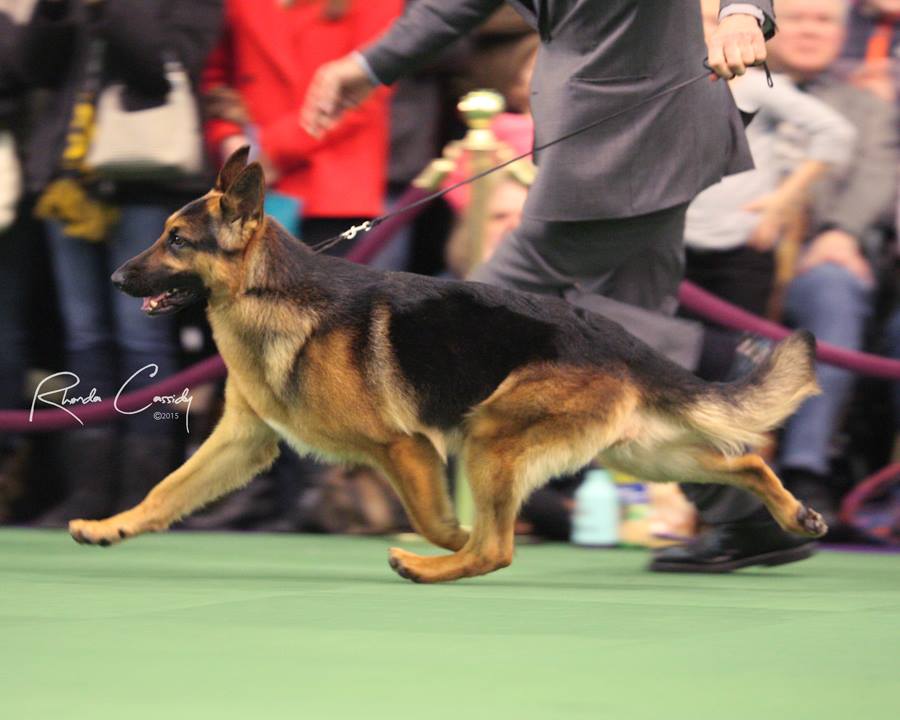
The #1 show dog in America is "Lockenhaus Rumor Has It V" which is pictured above, and below, walking on its metatarsus, with its hock almost touching the ground.
This dog won "herding" even though it cannot herd, and cannot even walk as a dog should.
A German shepherd should not walk on its metatarsals, and they did not used to.
Below is the gait of a wolf.
What have breeders done to wreck the German Shepherd?
Quite a lot.
And what would it look like if we did the same thing to a horse?
Puppies are furry, friendly and programmed for learning. Now is the time to teach your puppy about the things that people, especially kids might do, that dogs do not naturally accept. Things like toddlers pulling his tail, people taking his toys, kids going near his food bowl or kids taking over his special sleeping area.
To prevent biting accidents later in life you can condition your puppy to tolerate and even enjoy any kind of handling. Give him hugs, pull gently on ears and tail, tug gently on his fur all over while at the same time feeding him goodies from your hand, or allowing him to chew on a yummy bone. Pairing with a treat can make even rough handling a positive experience. It is essential to use the goody in this type of conditioning – just doing strange things to the puppy will not necessarily teach him to tolerate this from others. When that toddler runs up and yanks on his tail, the dog is more likely to look at you as if to say “where’s my treat?”, rather than snapping at the annoyance. This touch desensitization should be done monthly throughout the dog’s life. Watch this video that illustrates the process. It is best for parents to start the process, but kids can take over once the puppy shows acceptance and enjoyment of the activity. Only adults should do this with adult dogs.
Dogs do not naturally share, but you can teach your puppy to give up his toys, bones, food and resting place by associating the approach of people with great things. When you first get your puppy, feed him at least some of his food by hand. If he shows any sign of being unhappy with you near his food bowl, then feed all of his food by hand for the first two weeks. This teaches the puppy that hands near his food is good. As he is eating from his bowl walk by and toss something really yummy near the bowl, so that the puppy leaves the bowl to get the treat. This teaches the puppy that it is OK to move away from his bowl when a person approaches. After a few meals, move to tossing treats into his bowl while he is eating and then to putting your hand into the bowl with the treat. This teaches the puppy that people approaching means good things. Do not take the bowl and away and give it back. This teaches the puppy that you are unreliable and he needs to protect his food or eat it really fast!
Practice exchanges with your puppy, where you get him interested in something of equal value to the toy or bone that he is playing with and you give him yours and take away his. Or give him a great treat in exchange for his toy and then give the toy back. Sit with him in his resting place and give him toys and treats. Make sure that every experience the puppy has with people approaching his things or special places come with a great reward and you will have a puppy that is happy to share and is less likely to become defensive later in life.
Anyone who has experienced the thrill of teaching a dog new tricks knows exactly what it takes to get their dog to listen to their commands and it usually does work too. It is very exciting when you finally start to see the results from using your dog training techniques on your dog and it will motivate you to continue working with them to teach them even more. Instead of having a dog that just sits around doing nothing, you could have a dog that is totally fit to be involved in dog shows or anything else interesting such as that. One of the easiest commands to teach a dog would have to be, to sit. Teaching your dog to sit should come pretty easy, if you are consistent and praise them every time that they do listen to you. Normally within just a week of working with them, you should have a dog that listens to the sit command and you will just be tickled if this has never happened for you before now. Dog training can be a great deal of fun, both for the owner and their dog, if it is done correctly.
There are several different ways that you can go about teaching your dog how to sit whenever you tell him to and it is important for you to try a few different techniques with him and once you are seeing that he is listening to you finally, then you will know which technique to stick with. Some people can teach their dogs to sit just by saying it over and over and gently pushing down on their backside and once they do it then they are given a treat or a great deal of praise. Others find that taking something that the dog loves and kind of moving it slowly around their head and behind them, saying the word sit to them in a stern tone each time, works for them the best. It just depends on your preferences and what your dog responds to the best. Finding what works for you and your dog is what is important, do not let anyone else try and tell you how you should be doing it, if what you are doing does work. Advice is usually a good thing but for some reason there are those people that believe that they know what is best for you and your dog and sometimes that can really be annoying, so do what works for you ok.
Whenever you do decide to begin dog training your dog to teach them to sit for you, just remember to be patient with them because sometimes certain dogs might take a little bit longer to catch on than others would. Your dog can be your best little friend and when you do start seeing results from using your dog training techniques, you will just be totally excited and will be even more excited about showing it off to all of your friends and family members, so have fun with it!
Dog Training Resources
Kingdom Of Pets Dog obedience training by sitstayfetch. Learn how to obedience train your dog effectively to stop your dogs behavior problems.
Dog Food Secrets Increase the lifespan of your dog by up to 134%.
Dove Cresswells Puppy and Dog Training Online Dog Training Online offers dog training, puppy training, dog obedience training, puppy house training and dog house training, puppy potty training, crate training, dog potty training, crate training a puppy.
About The Author:
You DONT have to struggle with your dogs behavior issues any longer. Get the facts and eliminate your dogs behavior problems now. Grab your free 10 lesson report at http://infoblink.com/SitStayFetch.
Tags: dog, dogs, dog training, dog-training, dogtraining, dog obedience training, dog training tips, dog beds, dog toys, dog collars, dog food, dog care, dog health, pets, puppy, puppies, puppy training, puppy-training, pet, dog clothes, animal
Here is one of the most frequently asked questions about the content of the Be a Tree program:
Panting can be a sign of stress in a dog - why do you tell children that panting dogs are happy?
A panting dog is dealing with the stress by panting. A stressed dog that is not panting is much more dangerous because it has no mechanism to relieve the stress and is therefore more likely to react. Not all stress is bad stress. The dog might be waiting for a child to come and say hello. The waiting and wondering causes mild stress and the dog starts to pant. "Are we going for a walk?", "Are you going to throw that ball?", "Am I getting the cookie?" These are all circumstances that will cause panting due to mild stress and anticipation. We are trying to keep things simple for children and not providing an exhaustive course in dog behavior. Children obviously cannot be expected to tell the difference between a dog panting under mild stress or a dog panting with rapid frantic breaths that indicates extreme stress (still a dog less likely to bite than a highly stressed dog that is not able to pant).
Other things that the children learn during the program should prevent them from interacting with a dog panting out of extreme stress. They are taught to stand sideways and allow the dog to come to them to sniff their fist. A very nervous dog is apt to move away and not come forward to sniff - so they would leave that dog alone. They may also see the half moon eye, yawn, lick or the fore paw lift and realize that the dog is anxious. They are taught that if the dog stops panting if they come closer, that the dog does not want to meet or interact with them. Hopefully, handlers whose dog are very anxious will say no, when a child asks to pet the dog.
So for the most part a panting dog is a dog waiting with happy anticipation for something good to happen, or at least is a dog that is dealing with its stress. The panting/not panting differentiation is simple for children and immediately rules out many dogs that they may otherwise have wanted to pet and gives them a way to decide whether their own dog (who is the one most likely to bite them anyway) is open to interaction with them. We also teach that children should ask the dog handler to tell the dog to sit before they meet it. The cue "sit" is a stress reliever for most dogs because it is familiar and generally has a positive association and gives the dog some control of the situation. A dog that does not sit for the handler is not under sufficient control for a child to pet. An extremely anxious dog is unlikely to follow instructions and is ruled out on that basis, whether panting or not.


 Teaching your puppy to control his mouth and to keep his teeth to himself requires a multi-faceted approach which is a combination of management and training. In this article I will talk about the first of two very effective training approaches that you can take to help your puppy learn not to bite. These are as follows:
.jpg)


